

Author
Reactivation and retention are uncommon in Web3, so most projects pay for rented attention. This explains the lack of sustainable growth in the sector.
A reactivation campaign starts before the subject line. It starts with deciding what “inactive” means for your product, which users fit that definition, and whether you can reach them appropriately.
Without those decisions, a campaign can produce an attractive report while answering the wrong question. New visitors may be counted as returning users. Existing active customers may complete something they would have done anyway. People who cannot use the promoted feature may click, encounter a restriction and leave.
The practical way forward is to write the audience rule before writing the message.
Define inactivity around a useful action
“Inactive for 30 days” sounds precise. It still needs a second sentence: inactive in what way?
For a swap service, the meaningful event might be a completed exchange. For a wallet, it might be using a particular supported feature. For a software tool, it might be completing the task the customer originally adopted it to do.
Choose an event that reflects product value. A missed newsletter open is a communications signal; it does not, by itself, establish that someone stopped using the product.
The time window should also reflect how the product is used. A monthly task and a daily workflow need different definitions. Ask the product team what a normal return interval looks like before calling everyone outside an arbitrary window dormant.
Write the exclusion list
Consider an illustrative exchange campaign aimed at people who previously completed a swap but have not returned within an agreed period.
Before sending, exclude current active users, people who have never completed a swap, recipients who opted out, and anyone unable to use the proposed route. Validate the available identity and event data; do not assume that every wallet represents a different person.
These exclusions serve different purposes. Some protect relevance. Others respect recipient preferences or product eligibility. Together, they make the experiment easier to interpret.
A narrower, well-defined audience may be more useful than a larger group whose relationship with the product is unknown. The point is to answer a specific commercial question with a group that can actually answer it.
Separate acquisition from reactivation
Access to a relevant external audience can support an acquisition campaign. It does not automatically provide access to a company's previous customers.
Before describing a pilot as reactivation, establish how past product use will be identified, whether the audience can be matched, and what messaging permissions apply. Confirm which of those capabilities are available for the particular campaign.
If a reliable match is unavailable, adjust the brief. Run an acquisition experiment with its own success criteria. Keep any existing-user campaign separate so the report can explain where new and returning activity came from.
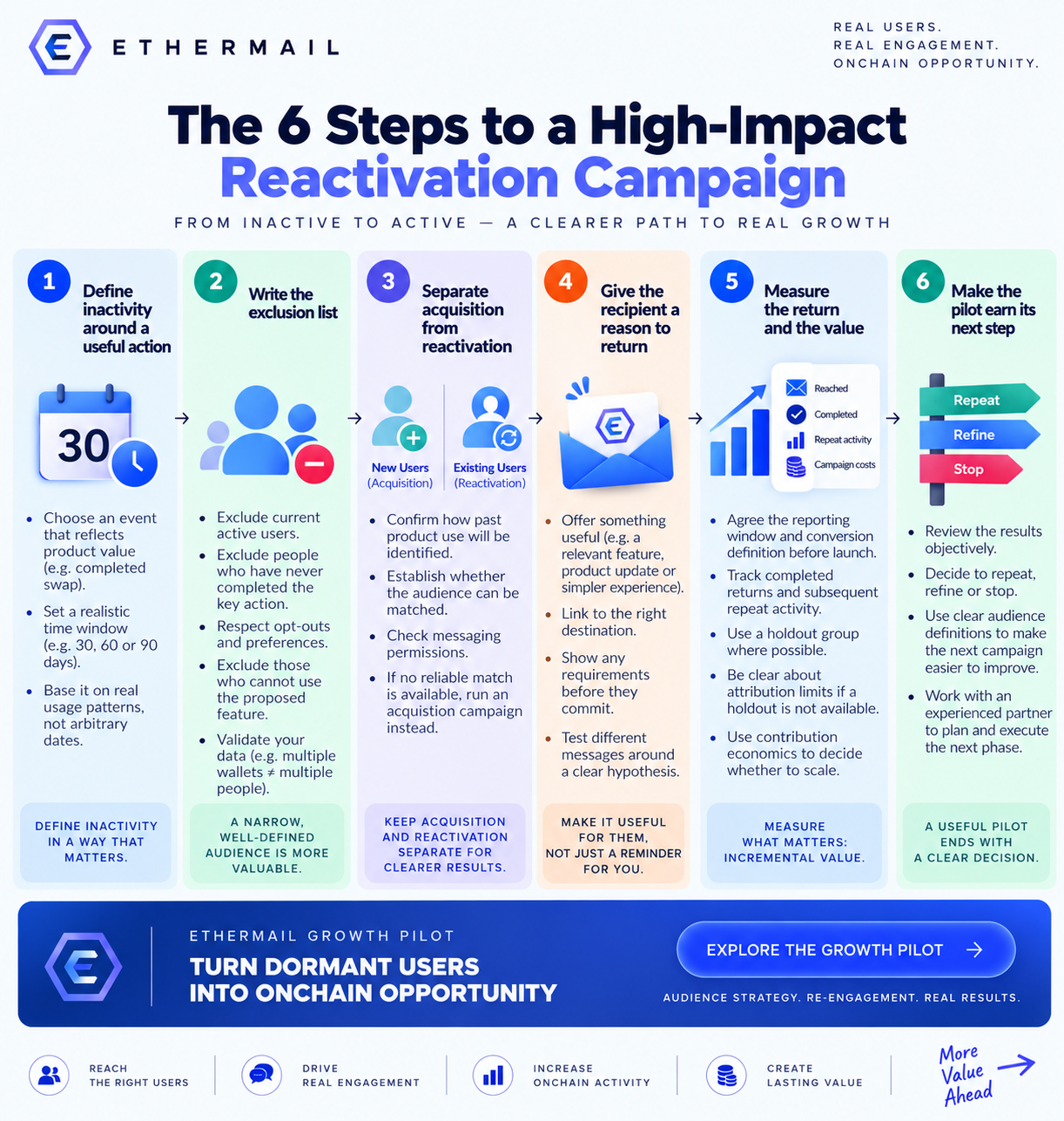
Give the recipient a reason to return
“We miss you” explains the sender's preference. The recipient needs a useful reason to act.
That reason could be an existing feature they have not tried, a simpler explanation of a task, or a relevant product change. Select something the product can deliver today and link to the appropriate destination.
For the illustrative exchange campaign, the message could explain how to compare options for a supported asset pair. It should lead into that journey, with any relevant requirements visible before the user commits.
Test the message around a clear hypothesis. For example: does explaining the next step produce more completed returns than a general reminder? That is a question to investigate, not a promised outcome.
Measure the return and the value
Agree the reporting window and conversion definition before launch. Track recipients reached, completed return actions, subsequent repeat activity and the costs associated with the campaign.
Where feasible, retain a comparable holdout group that does not receive the message. Its behaviour helps distinguish the campaign's contribution from activity that might have occurred anyway. If that comparison is unavailable, describe the attribution limits explicitly.
Use contribution economics when deciding whether to scale. Gross transaction volume and revenue are different measures; revenue and profit are different again. Ask the business owner which measure can support the next spending decision.
Make the pilot earn its next step
EtherMail's published Growth Pilot offering includes audience strategy and re-engagement work. The execution details still need to be agreed for each brief, including audience access, targeting, measurement and reporting. Explore the Growth Pilot.
A useful pilot ends with a decision: repeat, refine or stop. Clear audience definitions make that decision more credible—and make the next campaign easier to improve.
Read the business case for EtherMail’s Growth Pilot.

Connect with Daniel: Website | Telegram | Book a Call