

Author
Web3 marketing struggles with attribution. Discover how EtherMail’s tracking links enable precise measurement, real user action tracking, and accountable campaign performance beyond impressions and clicks.
In Web3, user acquisition is rarely the problem. Retention is.
Projects generate bursts of activity through token incentives, trading competitions, or quest campaigns, yet once the initial event ends, engagement drops off sharply because there is no structured way to reconnect with those users.
This creates a cycle of constant reacquisition, where marketing spend is repeatedly deployed to bring in users who were already engaged once before, but were never retained.
The underlying issue is simple.
Most projects do not own a direct communication channel with their users.
The Missing Layer: Ownership of Audience
In traditional Web2 environments, lifecycle marketing is built on owned channels such as email lists or CRM systems, where users can be re-engaged over time through structured communication.
In Web3, this layer is largely absent.
Projects rely on:
- -Discord servers that require constant monitoring
- -Telegram groups where messages are easily missed
- -Social feeds governed by algorithms
None of these provide reliable, direct, or permissioned access to users.
As a result, even when a project successfully acquires users, it has limited ability to bring them back at the right moment.
The EtherMail Growth Pilot: Building the Missing Infrastructure
The EtherMail Growth Pilot is designed to solve this by creating an owned, wallet-linked subscriber base over a structured three-month period.
Rather than focusing on one-off campaign performance, the pilot is built to establish a long-term communication asset that the project controls.
The objective is not simply to generate activity, but to capture and retain audience access.
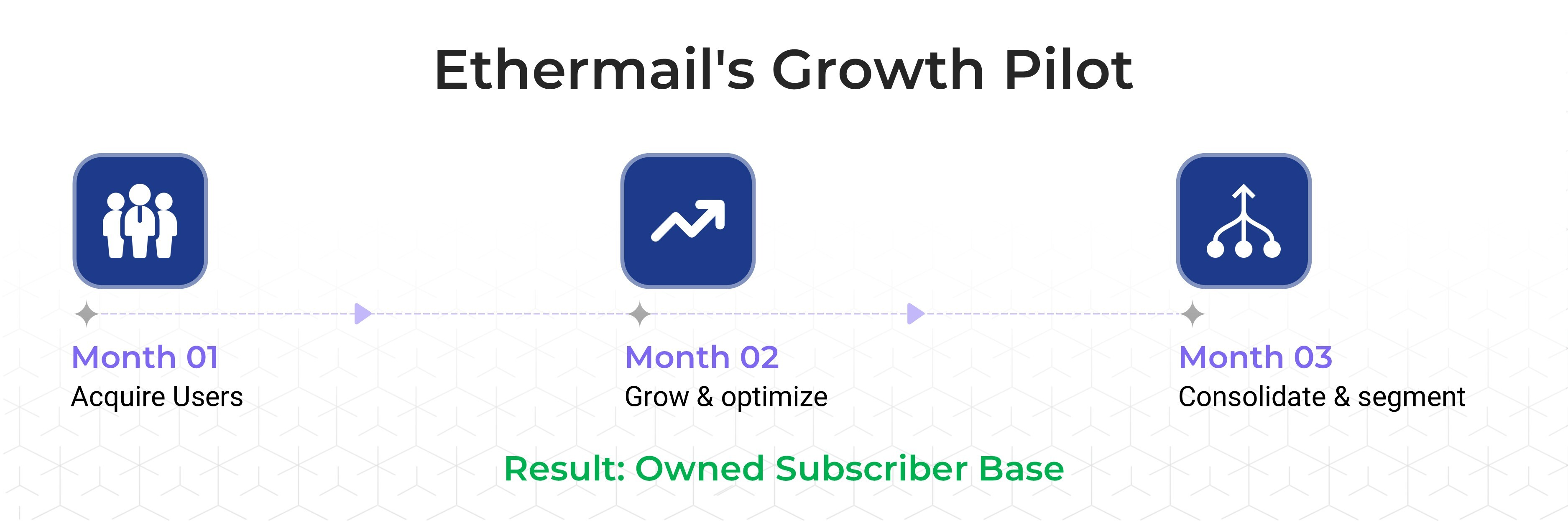
Month 1: Acquisition and Initial Subscriber Growth
The first phase focuses on acquiring users and converting them into subscribers within the EtherMail ecosystem.
Campaigns are deployed to:
- -Drive awareness of the project’s offering
- -Incentivise participation in live events or opportunities
- -Introduce users to EtherMail as a communication channel
As users engage, they opt in to receive messages through their wallet-linked inbox, forming the foundation of the subscriber base.
At this stage, the priority is scale and initial conversion.
Month 2: Acceleration and Optimisation
With an initial subscriber base established, the second phase focuses on accelerating growth and improving conversion efficiency.
This includes:
- -Refining messaging based on performance data
- -Identifying high-performing audience segments
- -Increasing visibility within the EtherMail onboarding flow
Campaigns become more targeted, leveraging insights from the first phase to attract users who are more likely to engage meaningfully.
Subscriber growth continues, but with increasing precision.
Month 3: Consolidation and Engagement Structuring
The final phase focuses on consolidating the subscriber base and preparing it for ongoing lifecycle messaging.
At this stage:
- -Messaging is aligned with specific user behaviours and interests
- -Engagement patterns are analysed to identify reactivation triggers
- -The subscriber base is stabilised as a reliable communication channel
By the end of the third month, the project has moved beyond initial acquisition into a position where it can communicate with users consistently and strategically.
The Outcome: An Owned Subscriber List
At the conclusion of the Growth Pilot, the project holds a fully established, wallet-linked subscriber base.
This is not a rented audience or a temporary campaign output.
It is an owned asset that enables:
- -Direct communication with users without reliance on third-party platforms
- -Re-engagement of users based on behaviour, holdings, or participation
- -Delivery of time-sensitive opportunities such as token incentives, governance actions, or product updates
Most importantly, it creates continuity.
Users acquired once can be reactivated multiple times.
From Acquisition to Lifecycle Messaging
Once the subscriber base is established, the focus shifts from growth to lifecycle management.
Projects can use EtherMail to:
- -Reactivate dormant users
- -Announce new campaigns or incentives
- -Drive repeat participation in trading, staking, or governance
- -Maintain ongoing engagement without restarting acquisition efforts
Why we Built the Growth Pilot
The effectiveness of the Growth Pilot lies in its alignment with how Web3 identity functions.
Because communication is tied to the user’s wallet:
- -Messages are relevant to actual on-chain behaviour
- -Users receive information aligned with their activity
- -Engagement is higher than broadcast-based channels
Combined with the read-to-earn model, this creates an environment where users have both contextual relevance and incentive to engage.
Conclusion
The EtherMail Growth Pilot is not simply a campaign structure.
It is a mechanism for building a persistent communication layer in Web3.
By focusing on subscriber acquisition, optimization, and consolidation over three months, it enables projects to move from fragmented outreach to owned lifecycle marketing.
In a landscape where attention is scarce and reacquisition is expensive, owning the ability to reach your users directly is not just an advantage, it is a necessity.
 Connect with Daniel: Website | Telegram | Book a Call