
Author
Most Web3 projects fail not because they can’t acquire users, but because they can’t retain them. Here’s why retention is broken and how to fix it.
Web3 has mastered acquisition.
It has not solved retention.
Projects routinely generate massive attention spikes. Token launches, airdrops, incentives, partnerships. Millions of users flow in over short periods of time.
Then they leave.
Quietly, consistently, and almost completely.
This is the $0 to $100M problem. Projects can create explosive growth moments, but they cannot sustain them.
And the reason is simple.
They do not have the infrastructure to retain users once the initial incentive disappears.
The Illusion of Growth
Most Web3 growth charts follow the same pattern:
A sharp increase in users
A short period of activity
A steep drop-off
It looks like success from the outside.
Internally, it is leakage at scale.
The majority of users acquired during campaigns never return.
Not because they are uninterested.
Because there is no system in place to bring them back.
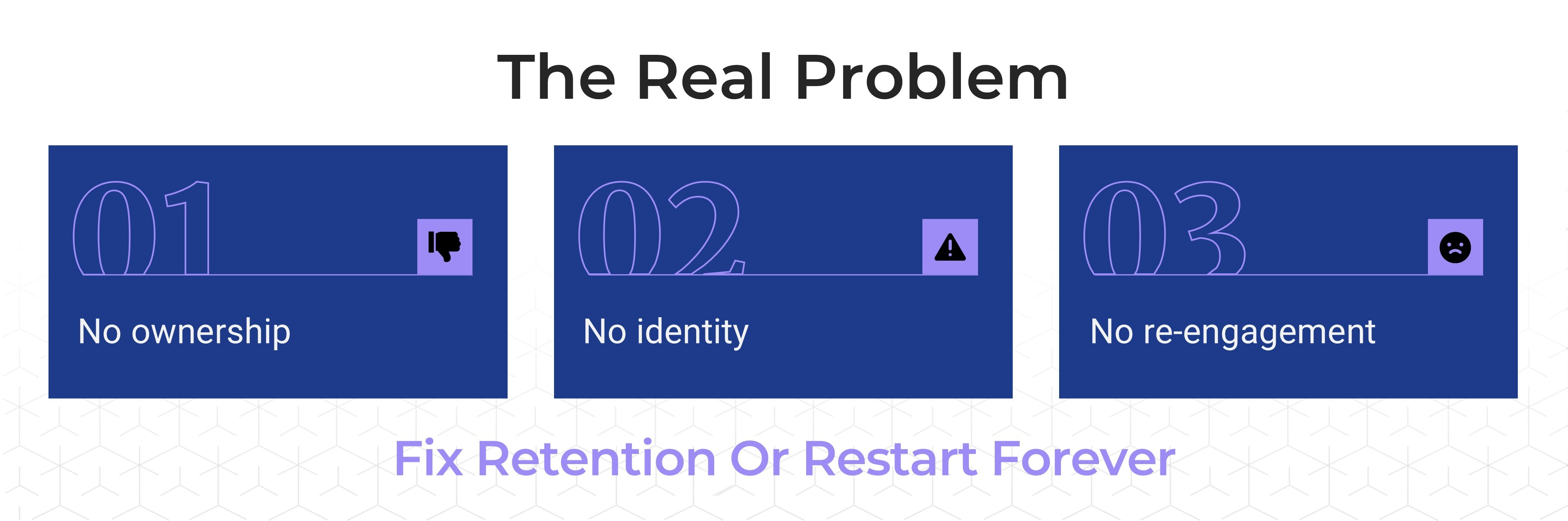
Why Retention Fails in Web3
Retention is not failing due to lack of effort.
It is failing due to structural weaknesses in how Web3 marketing operates.
1. Incentive-Driven Acquisition Without Lifecycle Strategy
Most growth is driven by:
Airdrops
Liquidity incentives
Trading competitions
Quest campaigns
These mechanisms are effective at driving short-term action.
They are not designed to build long-term engagement.
Once incentives end, so does user behaviour.
2. No Owned Communication Channel
After a user interacts with a protocol, what happens next?
In most cases, nothing.
Projects cannot:
Contact users directly
Send targeted follow-ups
Trigger reactivation campaigns
Without a direct communication layer, users simply disappear into the ecosystem.
3. Fragmented Identity
Users exist across multiple wallets, platforms, and interactions.
Projects lack:
A unified view of the user
Behavioural tracking across time
Meaningful segmentation
Without identity, retention becomes guesswork.
4. Over-Reliance on Community Channels
Discord and Telegram are often treated as retention tools.
They are not.
They are:
Noisy
Unstructured
Easy to ignore
Most users disengage long before they leave.
Projects just do not notice.
The Real Cost of Poor Retention
Retention failure is not just a marketing issue.
It directly impacts revenue and long-term viability.
Projects end up:
Re-spending on acquisition repeatedly
Failing to grow lifetime value
Struggling to sustain TVL or activity
Every campaign resets to zero.
This creates a dependency loop where growth is always temporary and always expensive.
The Shift: From Acquisition to Lifecycle Marketing
In Web2, retention is driven by lifecycle systems:
Email
CRM platforms
Automated campaigns
Users are continuously engaged based on behaviour.
Web3 lacks this layer.
Until now.
What Effective Retention Looks Like
A functioning retention system allows projects to:
Re-engage users after initial interaction
Send targeted messages tied to behaviour
Activate users around new incentives or features
Build ongoing relationships rather than one-off interactions
This is not a feature.
It is infrastructure.
Introducing the Missing Layer
Wallet-native communication bridges the gap between acquisition and retention.
By linking communication to wallet identity, projects gain:
A direct line to users
Permission-based messaging
A persistent audience they can re-engage
Instead of losing users after each campaign, projects retain access to them.
This turns short-term growth into a compounding asset.
From One-Off Campaigns to Compounding Growth
With a retention layer in place, the model changes:
Acquire users once
Capture them into an owned channel
Re-engage them repeatedly
Increase lifetime value over time
Each campaign builds on the last.
Instead of spikes, you get sustained growth.
Where EtherMail Fits
EtherMail provides this retention infrastructure.
With over 2.7 million verified wallets, it allows projects to:
Build a wallet-linked subscriber base
Send targeted campaigns tied to user behaviour
Reactivate users at key moments
This transforms growth from temporary bursts into ongoing engagement.
Conclusion
Web3 does not have an acquisition problem.
It has a retention problem.
Until projects can consistently re-engage users, growth will remain temporary.
The projects that solve this will not just grow faster.
They will outlast the rest.
CTA
If your growth depends on constant new user acquisition, you are rebuilding from zero every time.
Retention is the difference between momentum and stagnation.
Explore how EtherMail enables lifecycle marketing in Web3:
https://ethermail.io
 Connect with Daniel: Website | Telegram | Book a Call