.jpg)

Author
Traditional email providers like Gmail and Outlook are designed to block automated accounts. Here’s why AI agents cannot obtain email addresses today and why the agentic internet needs agent-native email infrastructure.
AI agents are becoming increasingly capable. They can write code, conduct research, book services, coordinate workflows, and interact with complex software systems. But the moment an agent tries to operate on the open internet, it runs into a surprisingly basic problem.
It cannot get an email address.
This may sound trivial. In reality, it is one of the biggest infrastructure barriers preventing AI agents from operating autonomously online.
The Internet Assumes Every User Is Human
Nearly every online service begins with the same step: account creation.
You open a new account on a website, enter an email address, confirm it through a verification link, and from that point onward your email becomes the anchor for your identity within that service. Confirmations, receipts, notifications, password resets, and account recovery all route through that inbox.
For humans, this system works well. For AI agents, it breaks immediately.
Modern email providers were built specifically to prevent automated account creation. Over the past decade, companies like Google, Microsoft, and Yahoo have invested heavily in systems designed to detect and block bots.
These defenses are effective against spam. They are also extremely effective at stopping legitimate AI agents from obtaining their own email accounts.
The Layers of Protection That Block Agents
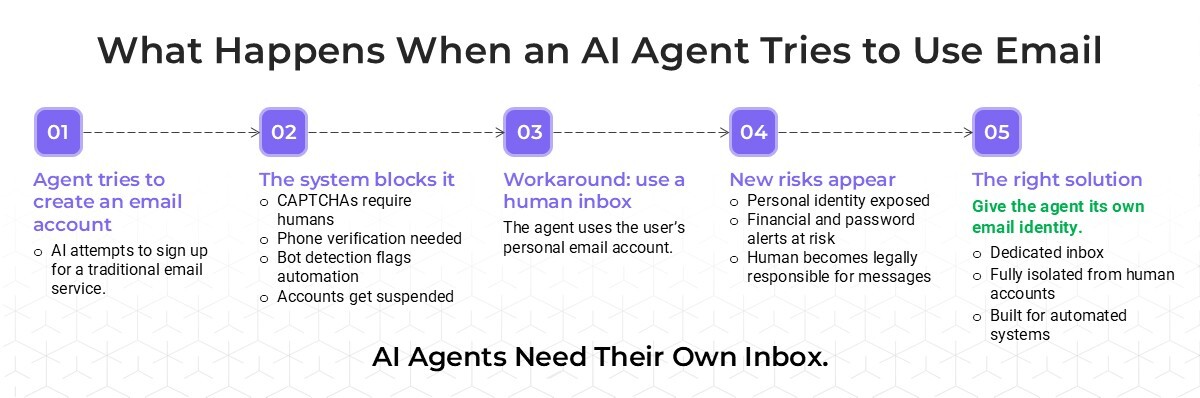
Try to create a Gmail account programmatically and you quickly encounter a series of barriers designed to require human participation.
The first is the CAPTCHA challenge. These tests require visual interpretation of distorted text or images. They are intentionally designed to be difficult for automated systems to solve.
Even if that challenge is bypassed, the next step often requires phone number verification. A one-time code is sent to a mobile device, creating another step that requires human intervention.
Bot detection systems monitor account behavior after creation. If a system detects patterns associated with automation, the account may be flagged or suspended within hours.
On top of these technical barriers, there are policy restrictions. Most major email providers explicitly prohibit automated account creation in their terms of service.
Taken together, these protections make it nearly impossible for AI agents to reliably obtain and maintain traditional email accounts.
Why Creating a “Spare Gmail” Doesn’t Work
A common workaround is to create a new email account manually and assign it to an AI agent.
At first glance, this seems reasonable. In practice, it creates several problems.
First, the account was still created for a human user. The moment the agent begins using it programmatically, it risks triggering automated detection systems that can suspend or lock the account.
Second, these accounts are not designed for automated control. Rate limits, authentication flows, and anti-bot systems make programmatic usage fragile and unreliable.
Third, these accounts still remain part of the human user’s identity footprint. If the agent signs up for dozens of services using that address, the account becomes a sprawling hub of automated activity that the user cannot easily audit or isolate.
What began as a simple workaround becomes an operational and security liability.
The Deeper Issue: Identity Infrastructure
The real problem is not Gmail itself. The problem is that the internet’s identity infrastructure was designed entirely around human users.
Email providers assume the person creating the account is sitting at a keyboard. Verification systems assume that person can read images, receive SMS messages, and interact with authentication flows designed for humans.
AI agents cannot satisfy those assumptions.
As agents begin performing more real-world tasks on the internet, this mismatch becomes impossible to ignore. An autonomous agent that cannot obtain its own email address cannot sign up for services, receive confirmations, or maintain persistent accounts.
In other words, it cannot function independently.
Why Agents Need Their Own Email Infrastructure
The simplest solution is also the most logical one: give agents their own email infrastructure.
Instead of forcing AI systems to masquerade as humans within existing email providers, agents should have identities designed specifically for automated systems.
An agent-native email system removes the barriers that make traditional providers incompatible with automation. There are no CAPTCHAs, no phone verification requirements, and no automated suspensions triggered by programmatic activity.
Agents can create accounts through APIs, send and receive messages reliably, and interact with online services just as human users do.
Just as importantly, these accounts remain completely separate from human inboxes.
A Necessary Step for the Agentic Internet
AI agents are beginning to move beyond chat interfaces and into real-world digital tasks. They book travel, manage subscriptions, handle customer support interactions, and coordinate complex workflows.
Almost all of these tasks require email.
Until agents have their own inboxes, their ability to operate independently on the internet will remain limited. They will either fail to complete tasks or rely on risky workarounds that expose human accounts.
As the number of autonomous systems grows, the internet will need identity infrastructure designed specifically for them.
Email remains the universal identity layer of the web.
The next step is making that identity available to non-human users.