

Author
Most Web3 projects were never real businesses. As speculation fades, weak token ecosystems and unsustainable models will collapse, leaving only projects with real utility, users, and revenue behind.
For years, Web3 operated on a simple, unspoken premise:
Raise capital.
Launch a token.
Hope something meaningful emerges later.
It worked. Until it didn’t.
Now the market is shifting from speculation to scrutiny, and a brutal reality is setting in:
Most Web3 projects were never businesses. They were token distribution events with a front-end.
And as liquidity tightens and attention fragments, the vast majority are about to vanish.
The Illusion of a Business Model
Let’s call it exactly what it was.
A typical Web3 “model” looked like this:
- -Launch a token
- -Drive hype through marketing, KOLs, and incentives
- -Attract users with airdrops or yield
- -Rely on token price appreciation as proof of success
There was no real revenue engine.
No sustainable unit economics.
No product people would pay for in the absence of incentives.
The token wasn’t supporting the business.
The token was the business.
That works in a bull market when new capital flows in to sustain the illusion.
It collapses the moment that flow slows down.
Liquidity Was Mistaken for Demand
One of the biggest strategic errors across the industry was confusing activity with product-market fit.
Projects saw:
- -High TVL
- -Surging wallet connections
- -Explosive user growth
And assumed they had built something valuable.
In reality, they had built something incentivised.
Remove the rewards, and the behaviour disappears.
Because it was never demand. It was rented attention.
This is the same disease that plagued Web2 growth hacks, just amplified with tokens.
The Death of the Airdrop Economy
Airdrops were positioned as community-building tools.
In practice, they trained an entire generation of users to behave like mercenaries.
- -Join
- -Extract
- -Leave
No loyalty. No retention. No long-term engagement.
When every user is optimising for extraction, your “community” is just a revolving door.
And once token emissions slow down, the machine stops.
Projects that relied on this loop are now facing the inevitable:
User bases that evaporate the moment incentives dry up.
No Revenue, No Runway, No Future
Strip away the token and ask a simple question:
Would anyone pay for this?
For most projects, the answer is no.
That’s the core issue.
- -No subscription revenue
- -No transaction fees of meaningful scale
- -No enterprise adoption
- -No defensible moat
Just a treasury funded by token sales, slowly bleeding out.
And unlike traditional startups, there is no clear path to pivot, because the token itself locks in expectations, incentives, and market perception.
Once confidence goes, it rarely comes back.
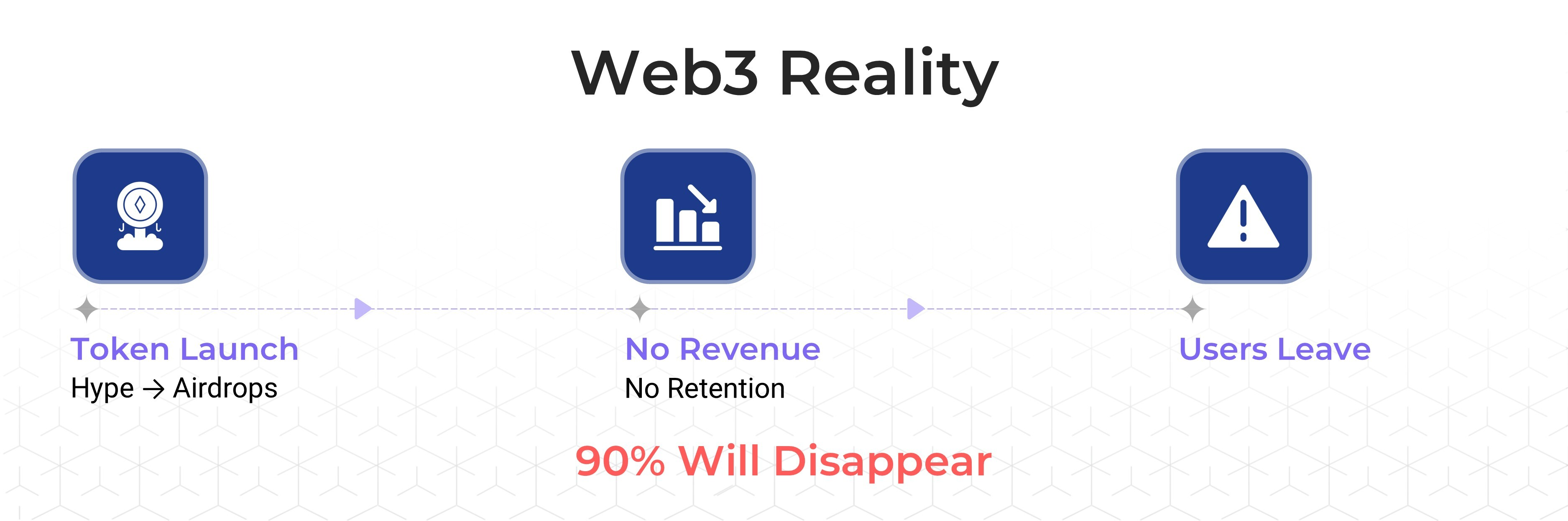
Why 90% Will Disappear
This isn’t hyperbole. It’s math.
Most projects are facing a convergence of pressures:
- -Declining token prices
- -Reduced retail participation
- -Higher user acquisition costs
- -Lower incentive budgets
- -Increased competition for attention
Without a real business underneath, they have no way to adapt.
-They cannot generate revenue.
-They cannot retain users.
-They cannot justify their existence beyond speculation.
So they will do what all unsustainable systems do:
They will fade, stall, and quietly die.
The Survivors Will Look Very Different
The projects that make it through this cycle will not resemble the majority of what exists today.
They will have:
- -Clear revenue models
- -Products users return to without incentives
- -Measurable value creation
- -Real retention, not temporary spikes
- -Distribution channels they own
They will treat tokens as tools, not lifelines.
And crucially, they will focus on driving behaviour, not just visibility.
Because attention without action is worthless.
From Hype to Execution
The industry is moving from:
-Visibility → Utility
-Speculation → Execution
-Engagement → Outcomes
That shift is painful, but necessary.
It forces projects to answer the only question that matters:
What value do you actually create?
Not what you promise.
Not what your token might become.
What happens today, when a user interacts with your product.
The Bottom Line
Web3 does not have a marketing problem.
It has a business model problem.
And until that is solved, no amount of impressions, clicks, or community growth will matter.
Because in the end, markets don’t reward narratives.
They reward outcomes.
The purge is already underway.
Most will not survive it.
And that’s exactly what the industry needs.
 Connect with Daniel: Website | Telegram | Book a Call