.png)

Author
Big communities don’t mean real growth. This article breaks down why most Web3 traction is shallow and how serious teams build sustainable distribution.
I spend a large chunk of my week on calls with Web3 teams who tell me they are “growing fast,” pointing to big Discords, big Telegrams, big impressions, and generally big vibes, and then I ask a simple question that tends to change the tone of the conversation.
How many real users took a measurable action in the last 30 days because of your marketing?
That is usually where the air leaks out of the room, because the numbers that sounded impressive a moment ago suddenly struggle to connect to anything that looks like revenue, retention, or meaningful product usage.
I am not saying teams are disingenuous; I am saying the industry has quietly agreed to measure the wrong things, clapping for follower counts, views, and “community size” while ignoring the only metric that actually pays salaries, which is user action tied to business outcomes.
I have seen projects with 500,000 followers that cannot get 500 people to click a link unless there is a token bribe attached, and I have seen “thriving communities” where the same 30 bounty hunters farm every campaign and disappear the second rewards dry up, which looks like growth on a dashboard but behaves like rented attention with an expiry date.
Here is the uncomfortable truth, most Web3 growth is theater, and like most theater, it is designed to look convincing from a distance while hiding how little is happening behind the scenes.
Airdrops create spikes, not loyalty, incentivized quests create activity, not attachment, and social metrics create noise, not users, so if your main distribution strategy depends on people who would not show up without a payout, you do not have a user base so much as a temporary labor force that will move on to the next campaign the moment the economics shift.
I learned this the hard way earlier in my career, when I was part of ecosystems where the narrative was strong, the branding was sharp, and the engagement dashboards looked fantastic, only to watch the “community” thin out as soon as incentives slowed, which forced me to admit that what we thought was product market fit was really incentive market fit, a distinction that sounds subtle but is brutally expensive and unsustainable.
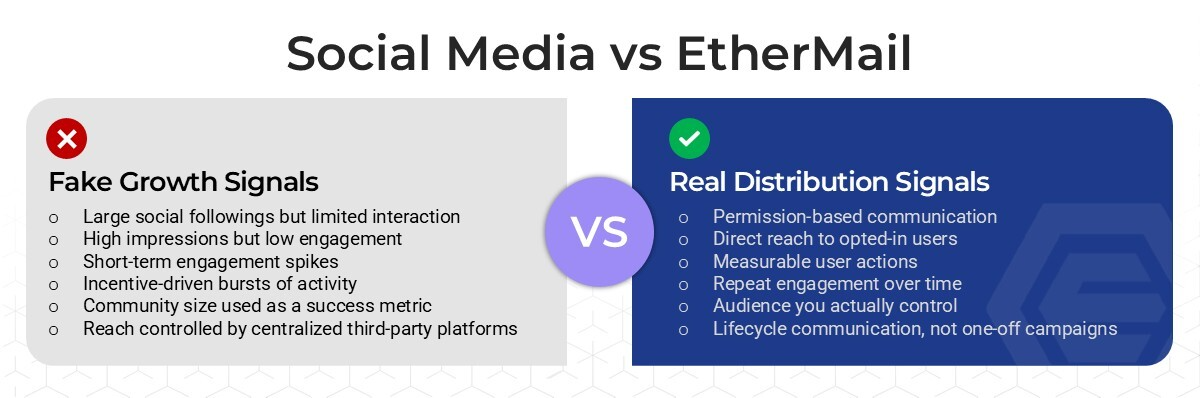
Real distribution looks different, and it is far less glamorous, because it is built on boring things like permission, consistency, and the ability to reach users without performing for an algorithm every time you have something to say.
Real distribution means you can reach your actual users directly without begging a feed for mercy, and it means you have a channel where messages are delivered because the user chose to be there, not because you temporarily gamed visibility, so when you say “we shipped a feature” or “we fixed a bug,” a meaningful percentage of real humans will actually see it.
Most teams do not have this, they have borrowed land in the form of Twitter followers they do not own, Discord servers where most members have notifications muted, and email lists full of addresses that were collected once and then slowly went cold, and then they wonder why every launch feels like shouting into a void that never shouts back.
When I talk to serious operators, the conversation shifts quickly from reach to control, from vanity metrics to ownership of the audience relationship, from raw impressions to whether they can segment users based on behavior and re-engage dormant users without paying a third party every single time, which is when marketing starts to look less like hype and more like infrastructure.
This is also where wallet level communication becomes interesting, not as a buzzword but as plumbing, because if a user connects a wallet and opts in to communication, that creates a persistent, permission-based line tied to identity in the ecosystem they actually use, rather than a fragile connection that disappears the moment an algorithm changes or a platform loses relevance.
From a sales perspective, the pattern is obvious, the teams that treat distribution as infrastructure consistently outperform the ones that treat it as a series of disconnected campaigns, because campaign thinking is short term and built around spiking charts for screenshots, while infrastructure thinking is long term and focused on building a channel, nurturing it, and compounding its value over time.
The irony is that the second approach is far less exciting to tweet about, because there is no viral thread celebrating the fact that “we built a reliable user communication stack,” but six months later one team can reliably drive users back into their product with a single message, while the other is still paying for attention like a tourist every time they want to make an announcement.
If you are leading growth for a Web3 project, ask yourself one question that cuts through the noise and forces an honest answer.
If all incentives stopped tomorrow, how many users could we still reach and move?
That number is your real distribution, and everything else is decoration.

Connect with Daniel: Website | Telegram | Book a Call