.jpg)

Author
A detailed analysis of why reaching wallets matters in Web3 marketing, and how aligning communication with onchain identity and behaviour enables more precise targeting, clearer attribution, and measurable outcomes.
One of the more persistent frustrations in marketing, particularly for those operating in performance-driven environments, is the gap between what we believe we know about users and what we can actually prove, because despite decades of advancement in analytics, targeting, and attribution, most marketing systems still rely heavily on inference rather than direct observation.
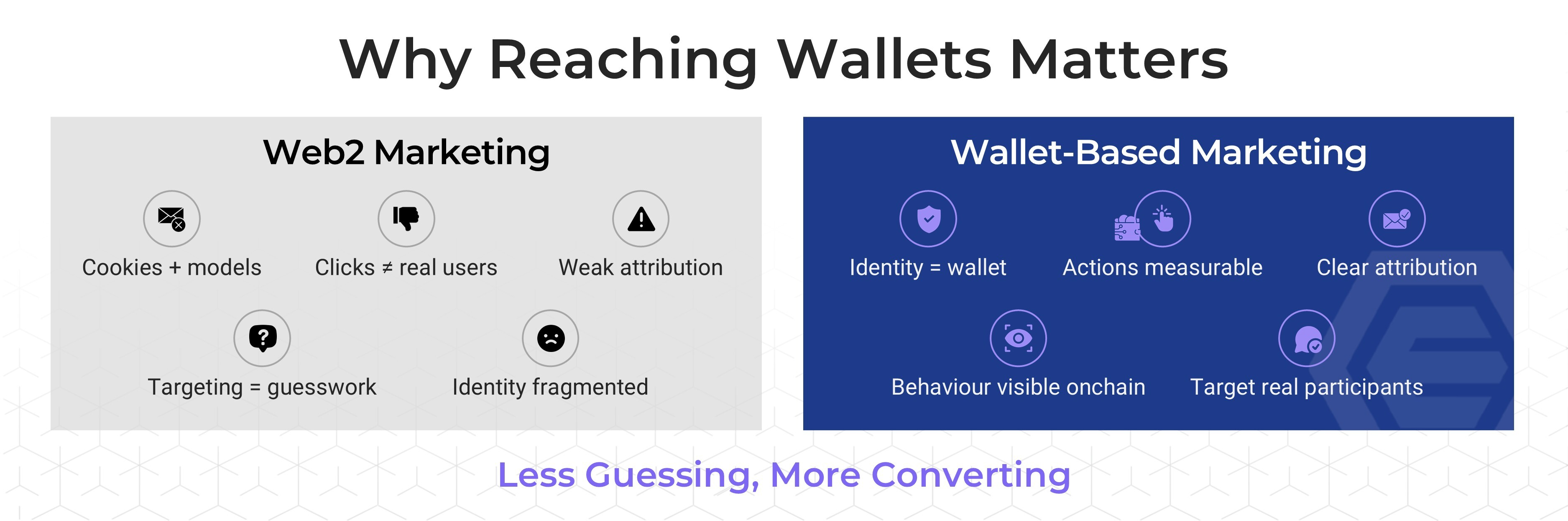
In Web2, identity is fragmented by design.
A single user may exist across multiple devices, accounts, and sessions, with their behaviour stitched together through cookies, login systems, and probabilistic models that attempt to reconstruct a coherent journey from incomplete data, which is why attribution has always been contested territory, and why even the largest platforms regularly disagree on where credit should be assigned for a given conversion.
The gradual erosion of third-party cookies, alongside increasing privacy restrictions from platforms such as Apple and Google, has only intensified this problem, forcing marketers to operate with less visibility while still being held accountable for outcomes that are expected to be precise.
Against that backdrop, most targeting begins to look like an educated guess.
You define audiences based on assumed interests, past interactions, or lookalike models, and then deploy campaigns into systems that optimise delivery according to engagement signals, all of which produces results that are directionally useful but rarely exact, and often difficult to tie back to meaningful economic activity.
Web3 introduces a fundamentally different starting point.
For the first time, identity and behaviour exist within the same system, because a wallet is not simply an identifier but a transparent record of participation, which means that instead of inferring what a user might value, you can observe what they have already chosen to do with their capital.
This distinction has significant implications for how marketing functions.
When you can see that a wallet has interacted with DeFi protocols, participated in governance, or provided liquidity within a specific ecosystem, you are no longer operating on the basis of assumed intent, but on demonstrable behaviour, which immediately increases the relevance of any communication directed at that user.
From my own experience working with campaigns that attempt to drive outcomes such as deposits, staking activity, or token participation, the difference between inferred audiences and behaviour-based targeting is not marginal, because the former tends to produce large volumes of low-quality engagement, while the latter consistently produces smaller but far more valuable interactions that are actually capable of moving metrics that matter.
This is where the ability to reach wallets becomes strategically important.
It is not simply another channel layered on top of existing infrastructure, but a means of aligning communication with identity in a way that reduces waste and increases precision, because instead of broadcasting messages to users who may or may not care, you are engaging directly with participants whose prior behaviour indicates a higher probability of action.
The impact of this alignment is most visible in conversion efficiency.
In traditional digital marketing, it is not uncommon to see click-through rates in the low single digits and conversion rates that are a fraction of that, which necessitates large volumes of traffic to produce meaningful results, whereas campaigns that begin with known participants are inherently more efficient, because they eliminate a significant portion of the funnel that would otherwise be spent qualifying users who were never likely to convert in the first place.
This compression of the funnel has both economic and operational consequences.
From a budget perspective, it reduces the amount of capital required to achieve a given outcome, because less spend is wasted on users who do not act, and from a measurement perspective, it produces cleaner data, because the relationship between message, action, and outcome is more direct and less dependent on attribution models that attempt to reconcile multiple touchpoints.
It is also worth noting that this level of visibility introduces a degree of accountability that is often absent in more traditional channels, because when user actions are recorded onchain, it becomes significantly more difficult to obscure performance behind vanity metrics such as impressions or engagement, which tend to dominate reporting in environments where true attribution is weak.
In this sense, wallet-based communication does not merely improve targeting; it alters the standard by which marketing performance is judged.
Rather than asking how many users saw a message or interacted with it superficially, the question becomes whether those users took meaningful action within the ecosystem, and whether that action can be directly linked to the communication they received.
This shift, while beneficial, is not always comfortable.
It removes a degree of ambiguity that many teams have historically relied upon, whether consciously or otherwise, and replaces it with a system in which outcomes are visible and therefore difficult to reinterpret.
However, for marketers who are genuinely focused on performance rather than presentation, this clarity is not a drawback but an advantage.
Ultimately, the reason a marketer should care about reaching wallets is not because it represents a novel concept, but because it resolves a set of problems that have persisted for years, namely fragmented identity, unreliable attribution, and inefficient targeting, by aligning communication with a system in which identity and behaviour are already unified.
Once that alignment exists, marketing begins to operate less as a process of approximation and more as a system of interaction grounded in observable reality, which, for anyone responsible for driving measurable outcomes, is a shift that is both difficult to ignore and increasingly difficult to operate without.