
Author
Explore why spam continues to dominate digital communication and how Web3 could create a future built on permission, relevance, and trust.
Spam has been part of the internet for decades.
Despite advances in technology, filtering systems, and security tools, unwanted messages continue to flood inboxes every day. The reason is surprisingly simple: spam works.
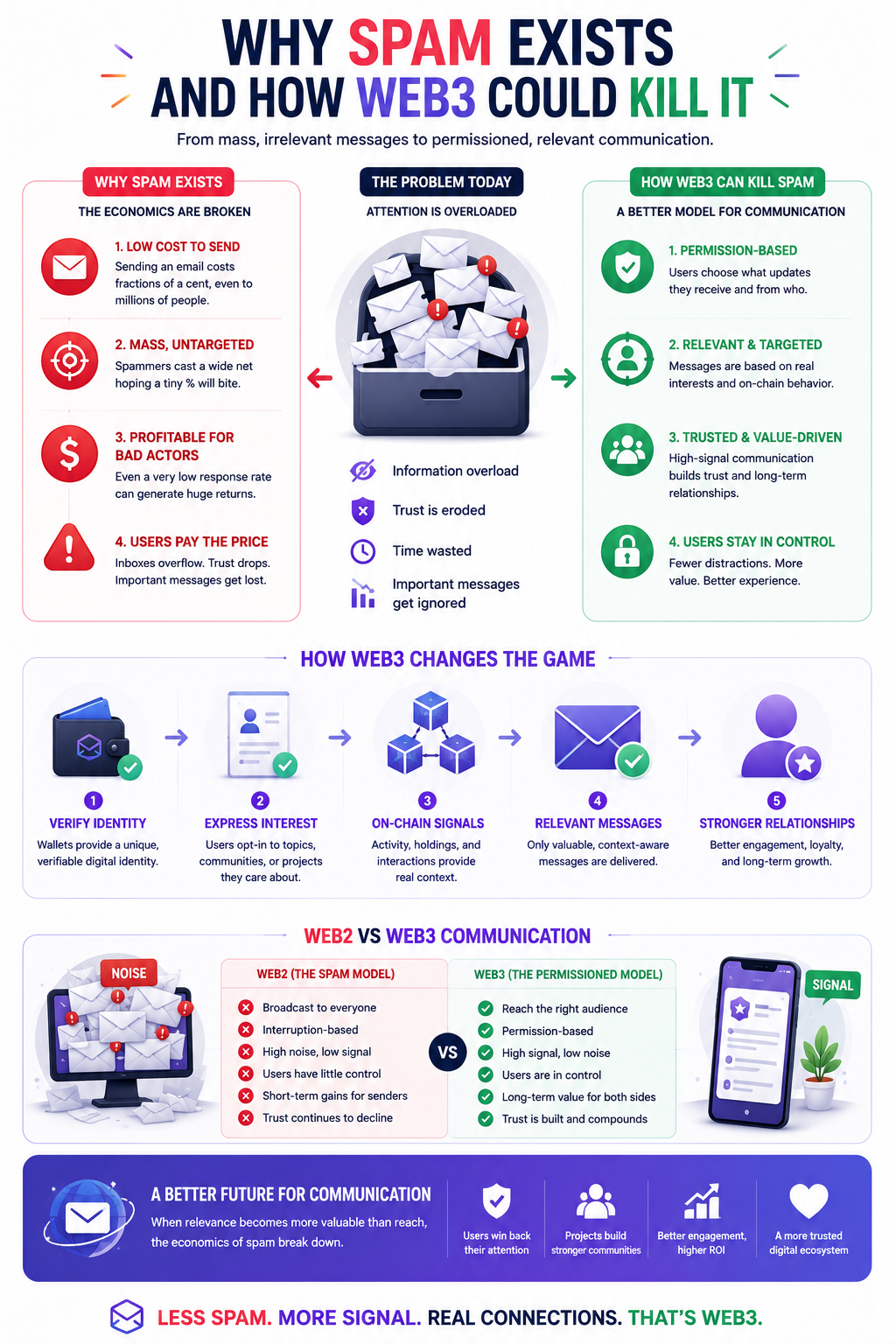
Even if only a tiny percentage of recipients engage with a message, sending millions of emails costs so little that the economics remain profitable for bad actors.
The problem is not just technology.
It is incentives.
The Economics of Spam
Traditional email was built for an internet that looked very different from today's digital landscape.
Sending an email is effectively free. Whether a sender contacts ten people or ten million people, the cost difference is relatively small.
This creates a system where quantity often matters more than quality.
Legitimate businesses must compete for attention alongside promotional blasts, phishing attempts, scams, and irrelevant marketing campaigns. Users become overwhelmed, engagement falls, and trust gradually erodes.
The result is an inbox that often feels more like a battlefield than a communication channel.
The Attention Crisis
Spam is no longer limited to email.
Users now receive notifications from social platforms, messaging apps, exchanges, wallets, communities, games, and countless other digital services.
Every platform wants attention.
Every platform wants engagement.
Every platform wants to be the first thing users check each morning.
As communication channels multiply, an unexpected problem emerges. Even valuable messages become easier to ignore.
The challenge is no longer access to information.
It is filtering signal from noise.
Why Permission Matters
The future of communication may depend less on sending more messages and more on sending better ones.
Permission-based communication creates a different relationship between senders and recipients. Instead of broadcasting messages to anyone who might listen, brands and projects communicate with users who have actively chosen to receive updates.
This changes incentives.
When users have greater control over what reaches them, irrelevant messaging becomes less effective. Communication becomes more targeted, more valuable, and ultimately more trusted.
Quality begins to outperform quantity.
A Web3 Approach
Web3 introduces new possibilities for solving communication challenges.
Wallet-based identities, on-chain activity, and permissioned engagement create opportunities for more relevant messaging. Instead of treating every user the same, projects can communicate based on actual interests, participation, and behavior.
A governance participant may receive governance updates.
A long-term holder may receive ecosystem news.
An active community member may receive opportunities that match their level of engagement.
The result is a more personalized experience without relying solely on broad demographic assumptions.
Beyond the Inbox
The goal is not simply to build another inbox.
The goal is to build better communication.
As digital ecosystems become increasingly fragmented, users need communication channels that respect their attention rather than compete endlessly for it.
Projects need ways to reach audiences without relying entirely on algorithms or crowded social feeds.
Spam emerged because the internet rewarded volume.
The next generation of communication may reward relevance instead.
And when relevance becomes more valuable than reach, the economics of spam begin to break down.