

Author
Why wallet based messaging is becoming core Web3 infrastructure, and how direct communication at the wallet level will replace email as the backbone of user engagement.
Since the daw of the internet, email has been the main way people prove who they are online. Every signup, password reset, product update, and marketing campaign has revolved around an email address. It became the common thread tying together a scattered digital world of apps, platforms, and logins. That system worked because the internet was built around company owned accounts, and email acted as the bridge between those walled gardens.
Web3 changes that foundation. The wallet is now the account. It is how users store value, sign transactions, access applications, and build a track record onchain. Nevertheless, communication is still stuck in the old model. Projects launch decentralized products, then rely on X, Discord, Telegram, and traditional email to try to connect to their users while at the mercy of algorithms. That disconnect is more than inconvenient. It is a structural weakness.
Email was never built to be a trust layer. Addresses are easy to create, easy to abandon, and rarely tied in any meaningful way to onchain behavior. A wallet, on the other hand, is a living record. It shows what someone holds, what they have interacted with, how long they have been around, and which communities they actually take part in. That information is not self reported. It is visible and verifiable. Transactions on wallets are exactly how we have proof of humanity when it comes to EtherMail's 2.7M verified users.
Despite this, most Web3 teams still operate across two separate worlds. Onchain data tells them who their users really are, while offchain communication channels operate blindly. The result is familiar. After the early hype fades, activity slows down. Communities end up relying on platforms where an algorithm can quietly bury their posts or cut off their reach without warning.
Projects try to build long term ecosystems while depending on attention they do not control.
A wallet native communication layer fixes this mismatch. Rather than pushing people into yet another Discord server or mailing list, projects can speak to them through the same wallet they already use to hold assets and interact onchain.
Messages are tied to the wallet itself, not to an email address that might be abandoned or forgotten a few months later. This creates a more stable, permission based channel where relevance is higher and trust grows naturally over time.
This is why wallet messaging should not be treated as just another marketing tool. It is part of the product experience. Governance updates, reward notifications, staking alerts, security warnings, and feature launches are not promotional extras.
They are essential information that users need in order to safely and effectively participate in a protocol. If those messages depend on social feeds or crowded chat rooms, they become unreliable. Important updates get missed, and engagement quietly erodes.
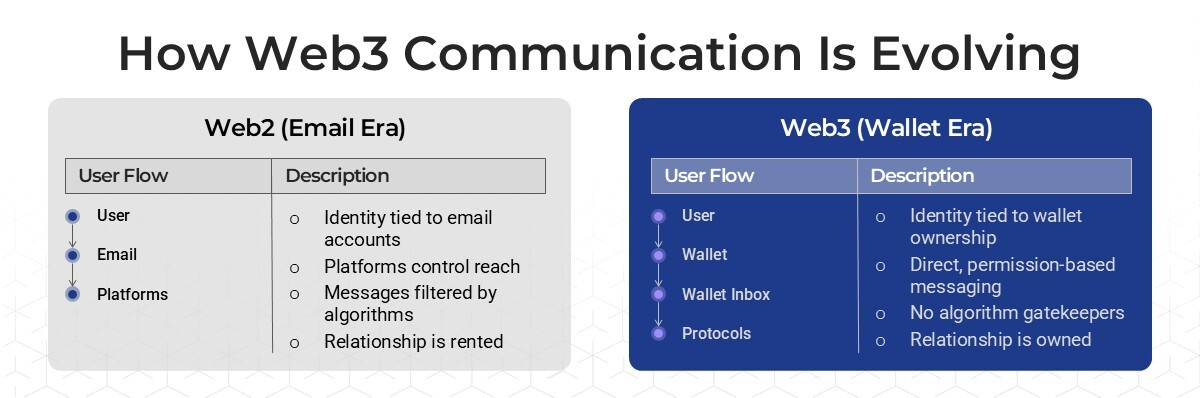
Every major shift in internet architecture eventually develops its own native communication layer. The early web had email. Mobile brought push notifications and in app messaging. Social networks built internal inboxes and direct messages.
Web3 is heading in the same direction. As more value and identity move onchain, users will expect important information to follow them there. They will not want to hunt across platforms to find updates that affect their assets, governance rights, or rewards.
For projects, the strategic difference is huge. Teams that rely only on rented platforms are building fragile distribution. Accounts can be banned. Reach can be throttled. Audiences can fragment overnight. In contrast, projects that establish direct wallet communication are building a line to their users that they actually control. Over time, that kind of direct connection builds momentum.
Users return more often, pay closer attention, and develop stronger trust in the protocol.
The shift in thinking is straightforward. Communication should not be something you tack on at the very end once the product is built. It needs to be considered part of the core Web3 stack. Just as nodes, indexing, and data availability are essential to how onchain applications run, a reliable way to reach users at the wallet level is essential to how those applications grow and stay healthy.
Wallets have already replaced accounts as the center of digital identity in Web3. It is only natural that they start to replace inboxes too. The teams that understand this early will not just communicate more effectively. They will build healthier networks where people know what is happening, stay involved, and remain aligned with the project for the long run.
 Connect with Daniel:

.jpg)