
Author
Discover why EtherMail makes email a high-ROI Web3 distribution channel with wallet intelligence, on-chain triggers and tokenized engagement.
Web3 has a distribution problem. Projects spend heavily on paid acquisition, influencers, social media, quests and community incentives, only to discover that attention is expensive to acquire and difficult to retain.
Yet one of the most commercially effective digital marketing channels already exists: email.
The economics are difficult to ignore. According to Litmus’ 2025 email ROI research, 35% of surveyed companies generate between $10 and $36 for every $1 spent on email, while another 30% report returns between $36 and $50.
There is a reason companies such as Mailchimp became giants. Email gives businesses a direct distribution channel to audiences they have already acquired. Modern platforms add segmentation, automation and behavioural targeting, allowing businesses to re-engage customers rather than repeatedly paying to reacquire their attention. Mailchimp’s email marketing platform, for example, centres on the tools that help brands build and activate an audience.
EtherMail takes those proven email economics and makes them wallet-native.
From Email Addresses to Wallet Intelligence
Traditional email platforms know subscribers through conventional customer data. Web3 provides another layer: the wallet.
EtherMail’s Marketing Hub allows campaigns to target wallets using criteria including token holdings, token types and attributes. It also supports on-chain triggers following interactions with smart contracts, tokens or NFTs.
That creates a fundamentally different type of distribution. A DeFi protocol can re-engage dormant users. An exchange can direct relevant wallet segments towards a new product. A staking platform can communicate with token holders. A Web3 game can reactivate members of its existing ecosystem.
The commercial objective is not simply impressions. It is deposits, trades, staking, usage, retention and reactivation.
Tokenizing Attention
EtherMail adds another mechanism unavailable in a conventional email stack: Read2Earn.
Through EtherMail’s consensual marketing model, users can receive rewards for engaging with promotional communication. EtherMail describes $EMT as its ecosystem token for rewarding participation in consensual marketing campaigns.
This introduces an economic incentive at one of marketing’s most difficult stages: getting the user to pay attention in the first place.
Instead of competing for attention purely through algorithms, advertising auctions or increasingly crowded community feeds, a project can communicate directly with an opted-in audience and incentivize engagement.
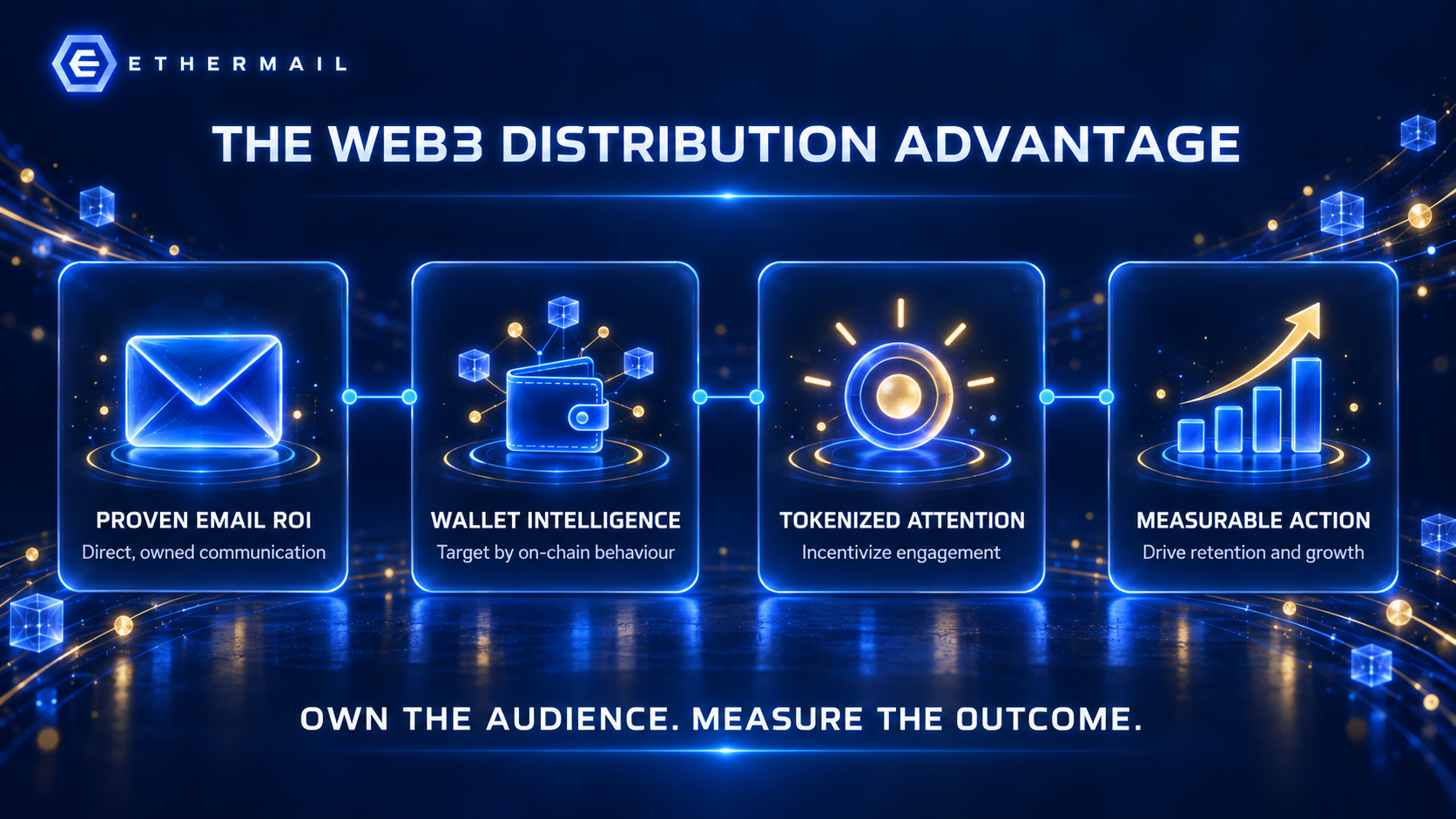
Proven email economics + wallet-based targeting + on-chain triggers + tokenized attention + measurable calls to action.
Web3 Does Not Need to Reinvent Distribution
Web2 already proved the value of email. The opportunity is to upgrade it.
Mailchimp helped establish email as infrastructure for digital customer communication. EtherMail extends that model into a world where customers are also wallets, behaviour happens on-chain and attention itself can be tokenized.
Web2 proved email works.
EtherMail makes email work for Web3.