
Author
Discover the hidden cost of reacquisition in Web3. Learn why retaining existing users delivers better ROI than constantly paying to win them back.
Most Web3 projects obsess over acquisition.
Marketing teams spend months planning token launches, partnership campaigns, influencer promotions, paid advertising, and community growth initiatives. Every effort is focused on bringing new users into the ecosystem.
Yet many projects overlook a much more expensive problem.
They keep paying to acquire the same users over and over again.
A user discovers a project, signs up, connects a wallet, participates in an event, and then disappears. Months later, the project launches a new campaign and spends additional resources trying to bring that same user back.
This cycle repeats across the industry.
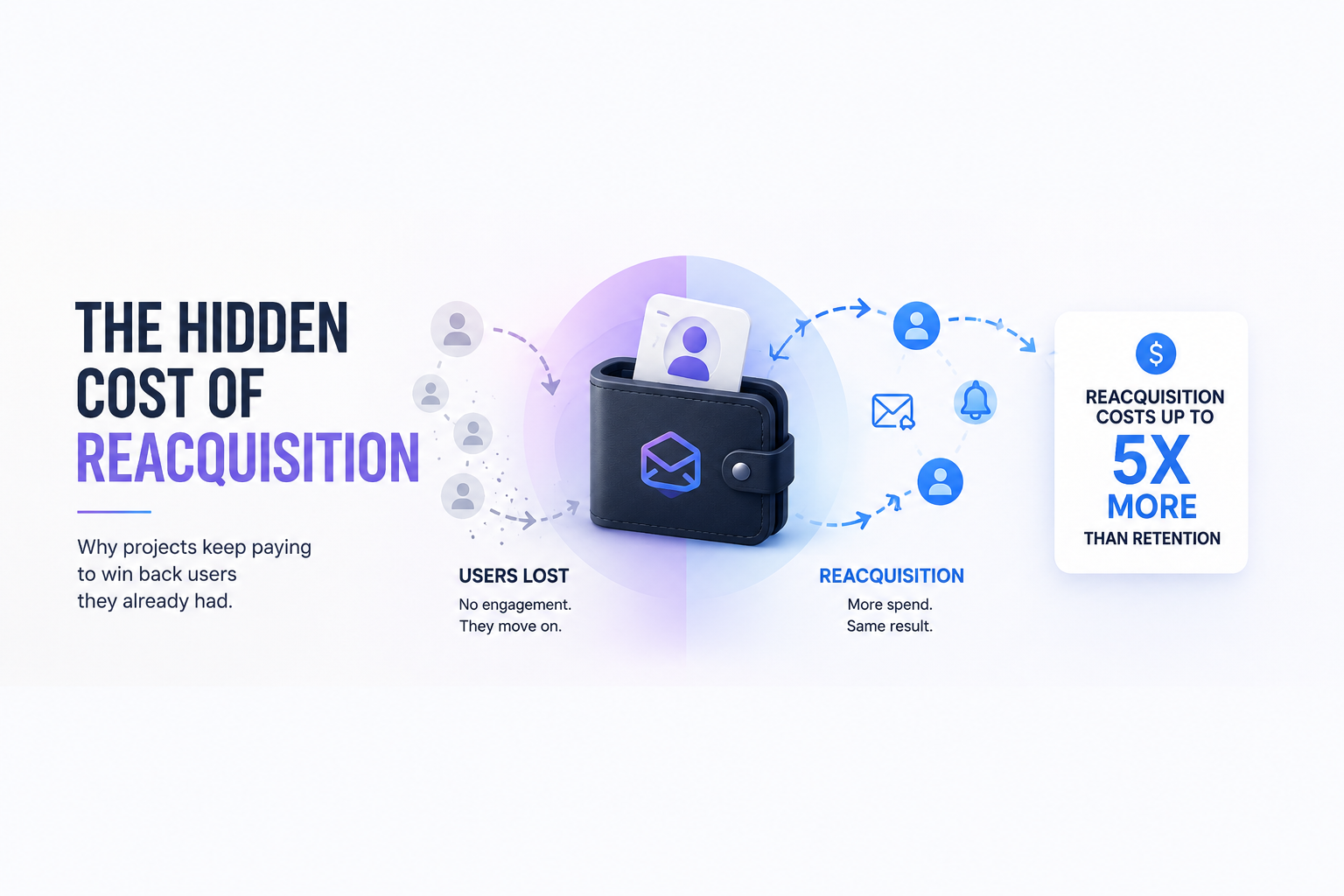
The result is a hidden cost that rarely appears in marketing reports: reacquisition.
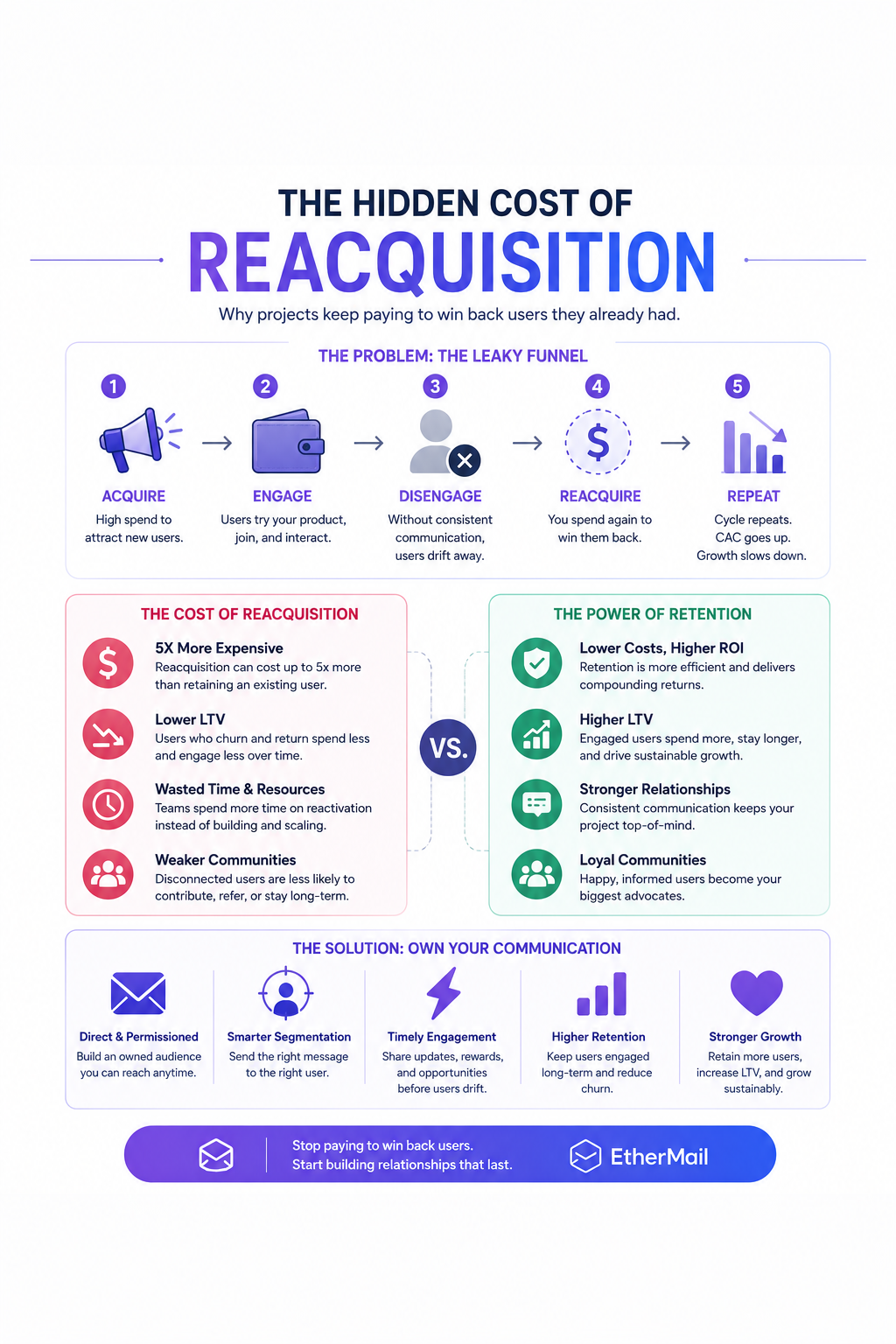
The Leaky Funnel Problem
For many Web3 businesses, acquisition is not the biggest challenge. Retention is.
A protocol may attract thousands of wallet holders during a token generation event. An NFT collection may generate significant attention during mint. A gaming project may see strong initial participation following launch.
However, without consistent communication, users gradually disengage.
The project still has the wallet addresses. It may even have on-chain visibility into user activity. What it often lacks is an effective way to maintain the relationship.
As attention shifts elsewhere, users become increasingly expensive to re-engage.
Why Reacquisition Costs More Than Retention
Traditional businesses learned this lesson years ago.
Retaining an existing customer is typically far cheaper than acquiring a new one. Existing customers already understand the product, trust the brand, and require less education.
The same principle applies in Web3.
A user who has already connected a wallet, claimed rewards, participated in governance, or used a protocol has crossed the hardest barrier: initial engagement.
Losing that user and attempting to win them back later creates unnecessary costs.
Every dollar spent reacquiring former users is a dollar that could have been invested in deepening existing relationships.
Communication Is the Missing Layer
Many Web3 projects have strong products but weak communication infrastructure.
Communities become fragmented across social platforms, messaging apps, and multiple wallets. Important updates compete with thousands of other notifications.
When users stop actively checking a project's channels, the connection weakens.
This is where lifecycle communication becomes critical.
Instead of only communicating during launches, projects need ongoing engagement strategies that keep users informed about new features, rewards, governance opportunities, and ecosystem developments.
The goal is simple: remain present before users drift away.
The Projects That Win
As the Web3 industry matures, sustainable growth will depend less on attracting new users and more on maintaining relationships with existing ones.
Projects that build direct communication channels gain a significant advantage. They reduce churn, improve engagement, and create stronger long-term communities.
The most successful projects of the next decade may not be the ones with the biggest marketing budgets.
They may be the ones that spend less time reacquiring lost users and more time keeping the users they already have.
Growth is not only about reaching new audiences.
Sometimes the most valuable users are the ones who have already raised their hand once.